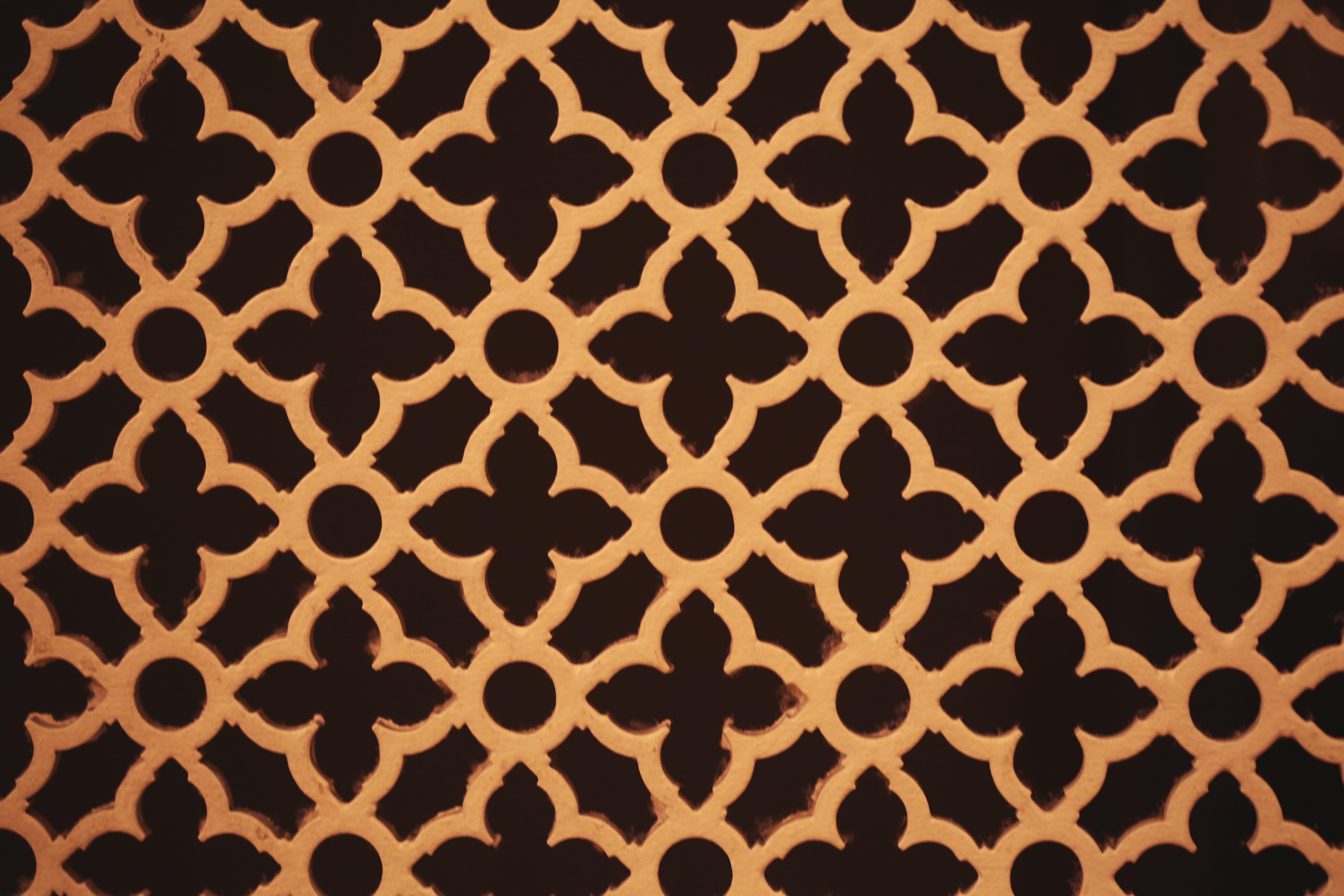
Throughout history, cultures around the world have developed sophisticated geometric traditions. Each offers a unique lens through which to understand pattern, proportion, and meaning.
Star patterns, infinite tessellations, and radial symmetry that express the infinite nature of creation. The precision of Islamic geometry reflects a worldview where mathematics reveals divine order.
Concentric geometric diagrams used as meditation tools, representing the cosmos through interlocking triangles and circles. The Sri Yantra, with its nine interlocking triangles, is one of the most sophisticated geometric diagrams ever created.
Endless loops and interlocking patterns that symbolise eternity and connection. Celtic knots have no beginning and no end—a musical equivalent might be a canon or round that never resolves.
Circular structures representing the cycles of life, the seasons, and the directions. These wheels encode astronomical knowledge and spiritual understanding through geometric relationships.
Patterns that map the land, connecting geography, story, and music. Songlines are both navigation systems and musical compositions—pattern and place are inseparable.
Pythagorean ratios, Platonic solids, and the idea that mathematics reveals the structure of reality. The Greeks saw geometry as the language of the cosmos, a view that directly influenced Western music theory.
Cyclical patterns and astronomical observations that linked time, ritual, and cosmic order. The Mayan calendar system encodes complex mathematical relationships that generate repeating cycles.
Recursive patterns found in art, architecture, and village design. African fractals demonstrate sophisticated mathematical understanding expressed through cultural forms.
Binary patterns and hexagram sequences that encode change and transformation. The I Ching's 64 hexagrams form a complete system for understanding pattern and process.